TACODomain-Specific Multi-Level IR Rewriting for GPU: The Open Earth Compiler for GPU-Accelerated Climate Simulation
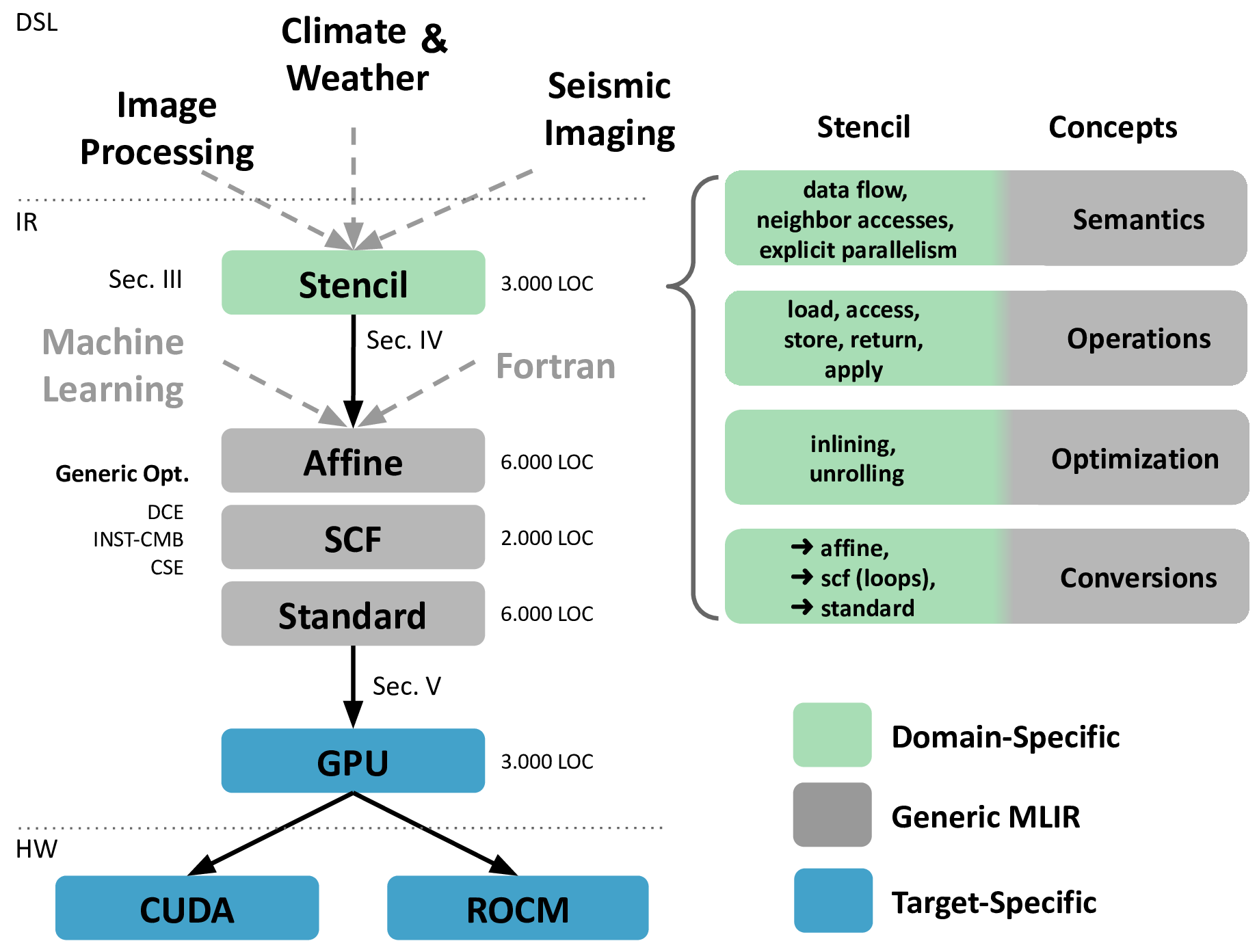
Most compilers have a single core intermediate representation (IR) (e.g., LLVM) sometimes complemented with vaguely defined IR-like data structures. This IR is commonly low-level and close to machine instructions. As a result, optimizations relying on domain-specific information are either not possible or require complex analysis to recover the missing information. In contrast, multi-level rewriting instantiates a hierarchy of dialects (IRs), lowers programs level-by-level, and performs code transformations at the most suitable level. We demonstrate the effectiveness of this approach for the weather and climate domain. In particular, we develop a prototype compiler and design stencil- and GPU-specific dialects based on a set of newly introduced design principles. We find that two domain-specific optimizations (500 lines of code) realized on top of LLVM’s extensible MLIR compiler infrastructure suffice to outperform state-of-the-art solutions. In essence, multi-level rewriting promises to herald the age of specialized compilers composed from domain- and target-specific dialects implemented on top of a shared infrastructure.
Cite
@article{gysi2021ooc,
  author = {Gysi, Tobias and M\"{u}ller, Christoph and Zinenko, Oleksandr and Herhut, Stephan and Davis, Eddie and Wicky, Tobias and Fuhrer, Oliver and Hoefler, Torsten and Grosser, Tobias},
  title = {Domain-Specific Multi-Level IR Rewriting for GPU: The Open Earth Compiler for GPU-Accelerated Climate Simulation},
  journal = {ACM Trans. Archit. Code Optim.},
  series = {TACO},
  volume = {18},
  number = {4},
  year = {2021},
  month = {9},
  publisher = {Association for Computing Machinery},
  address = {New York, NY, USA},
  doi = {10.1145/3469030},
  url = {https://doi.org/10.1145/3469030},
  issn = {1544-3566}
}